Projection Screens
A multi-client study from AV Market Insights
Introduction
AV Market Insights is launching a syndicated, multi-client study examining the global market for Projection Screens. Those participating in the study will enjoy the cost benefits of a multi-client project while also gaining from our unique collaborative approach providing for close interaction and addressing specific information needs. AV Market Insights helps companies grow and expand in the dynamic global audiovisual (AV) market by providing accurate market data, analysis, and insight into niche product segments. Our global team of experienced professionals helps clients thoroughly understand these niche segments' market dynamics, opportunities, and trends. We are unique in our focus on the AV market and delivering market insights primarily through multi-client studies involving close collaboration with clients. We are unique in focusing on the AV market and delivering market insights primarily through collaborative multi-client studies. You will be able to provide input on the research scope while also receiving updates, preliminary information, and providing feedback throughout the research process. In-depth, personal interviews with manufacturers and channels – distributors, integrators, VARs, and dealers – will help to supplement quantitative information – such as market size and growth rates – with insights on key trends, issues, regional differences, and channel dynamics. Those insights will include an analysis of the implications for the reader, making the information actionable.
Product Segmentation
Motorized Wall and Ceiling Screens: These are screens that can be retracted or extended with the help of an electric motor. They are typically mounted on walls or ceilings and can be controlled remotely, making them a convenient option for both commercial and residential spaces. Motorized screens are ideal for multi-use spaces where the screen needs to be hidden when not in use, such as in-home theaters, conference rooms, and classrooms.
Fixed Wall Screens: Fixed wall screens are permanently mounted screens that provide a stable and constant viewing area. These screens are stretched and mounted onto a frame that is fixed to a wall, ensuring a flat viewing surface at all times. They are commonly used in dedicated cinema rooms, auditoriums, and places where a permanent, high-quality projection surface is required.
Folding and Staging Screens: This segment includes large, modular screens that can be easily assembled and disassembled for events, stage performances, and large presentations. Folding and staging screens are designed for portability and flexibility, accommodating both front and rear projection. They are suitable for temporary setups, such as in trade shows, outdoor events, and conference centers.
Tripod and Portable Screens: Portable screens, including those that can be mounted on tripods, are designed for mobility and ease of use. These screens can be quickly set up and taken down, making them ideal for presentations on the go, educational purposes, and small-scale outdoor movies. Tripod screens, in particular, offer stability and can be adjusted in height, making them versatile for various viewing environments.
Specialized Format Screens: This category encompasses screens designed for specific projection formats such as HDTV, widescreen, and letterbox, as well as screens that can support multiple aspect ratios for versatile content display. These screens cater to the specific needs of different types of content, ensuring optimal image quality and aspect ratio for everything from cinematic presentations in home theaters to educational content in classrooms and professional presentations in corporate environments.
Geographic Segmentation
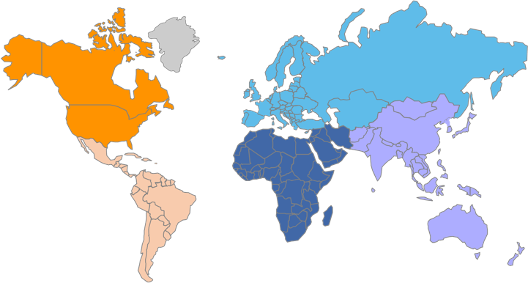
- North America
- Latin America
- Europe
- Middle East
- Africa
- Asia-Pacific
Issues To Be Addressed
Market Size and Growth
- Define the parameters of the market (by product segment and geography).
- Assess the market’s overall growth rates (by product segment and geography).
- Determine the growth drivers of each product segment and geography.
- Analyze metrics that can be used to track growth drivers.
Channels and Opportunities
- What are the trends and dynamics associated with the various channels?
- How are channels changing? What are the implications of these changes?
- What do channel partners perceive as the critical success factors for suppliers in each product category?
- What opportunities, vulnerabilities, trends, and drivers do suppliers and channels see?
- Which growth strategies are working and which are not?
Market Trends and Dynamics
- Analyze and describe key trends.
- What are the trends and dynamics associated with the product segments and geographic regions?
- Identify the major opportunities and threats for the key product segments.
- Determine the key factors necessary for suppliers to maintain healthy growth rates.
- Identify and describe emerging trends and technologies that will impact the market within the next three to five years.
- Where are the greatest opportunities for growth?
- Which countries or regions represent the best opportunity for sales?
- What market entry strategy has worked best for successful companies?
- What are the primary barriers to growth?
Research Methodology

We do the hard work of extensive, in-depth interviews with suppliers, channels, and industry experts, combined with secondary research, to deliver an accurate, insightful understanding of AV markets. Global-level data will be gathered from leading suppliers and other sources, and then broken down into segments and sub-segments of the market. At the same time, country and regional-level data will be gathered from local channels and the local offices of suppliers and then built up into regional- and global-level data. Data from the two processes will be compared and reconciled to ensure a high level of accuracy and integrity in the final market data. Data will be gathered through a combination of secondary research and personal, deep-dive interviews.
Secondary Research
Secondary research will draw on a wide range of data sources to obtain relevant data. Published revenue figures for publicly listed companies will be especially helpful in developing high-level global estimates. Information gathered from secondary research will also support the interview process and make the interviews more effective. The secondary research will be used to help develop initial estimates of global market size; gather as much segment-specific market data as possible; obtain information on the companies targeted for interviews to make interviews more effective; and obtain supplementary information on market trends, issues, drivers, and constraints.
Primary Research
In-depth, quality interviews are important to understanding the global AV market. Primary research will involve at least 70 personal, deep-dive interviews with manufacturers, distributors, service providers, integrators, VARs, and dealers across all regions. Approximately one-third of the interviews will be with suppliers, with the remaining two-thirds being channel and industry expert interviews. The interviews will gather sales and growth estimates, while also seeking to understand key issues, trends, drivers, and constraints.
